European PE firms shift toward operational improvement and balanced value creation - Alvarez & Marsal

European private equity firms are increasingly relying on a combination of revenue growth, cost optimization and operational improvements to create value as higher interest rates, longer holding periods and a tougher exit environment reshape the industry, according to a new report published by Alvarez & Marsal.
The study found that 43% of private equity investors and portfolio company executives now view an equal mix of revenue and cost initiatives as the main driver of value creation, reflecting a shift away from strategies that relied heavily on rapid dealmaking, cheap debt and favorable market conditions.
An analysis of European exits found that EBITDA margin improvement accounted for 51% of EBITDA growth among companies exited in 2025, up from roughly 21.5% before 2023, while the contribution from revenue growth fell to 49% from 78.5%.
The report said private equity firms are becoming more hands-on in portfolio management and are moving earlier to implement value-creation plans. Fifty-eight percent of respondents said value-creation resources are now deployed within the first 100 days of ownership, up from 29% a year earlier. However, execution remains challenging, with 65% reporting that less than half of value-creation plans developed over the past two years have been fully realized.
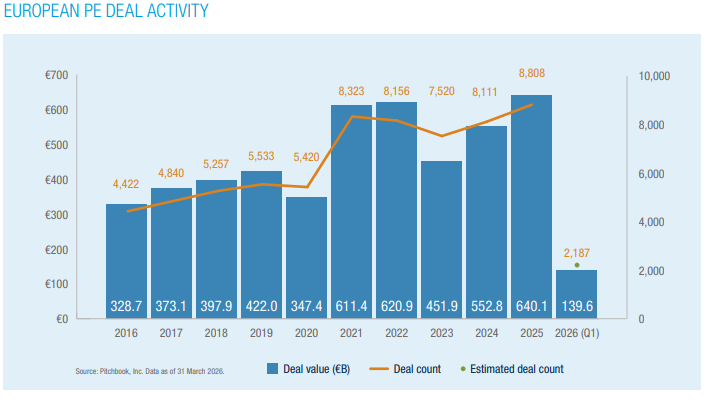
The findings come as the European private equity market continues to grapple with a difficult operating environment. While European deal value recovered to €640.1 billion in 2025 from €552.8 billion a year earlier, geopolitical tensions, supply-chain disruptions and higher energy costs have created fresh uncertainty in early 2026, the report said.
Geopolitical instability was identified as the biggest challenge to value creation, cited by 62% of respondents, ahead of trade volatility and tariffs at 58% and persistent inflation and higher interest rates, also at 58%. The report said firms are increasingly focusing on supply-chain resilience through measures such as nearshoring, dual sourcing and supplier diversification.
Working-capital management and organic growth are expected to become even more important over the next year. Eighty-three percent of respondents said working-capital initiatives would increase in importance, while 81% expected greater emphasis on organic revenue growth. Pricing was identified as the most important revenue-growth lever, cited by 68% of respondents, ahead of customer acquisition and cross-selling initiatives.
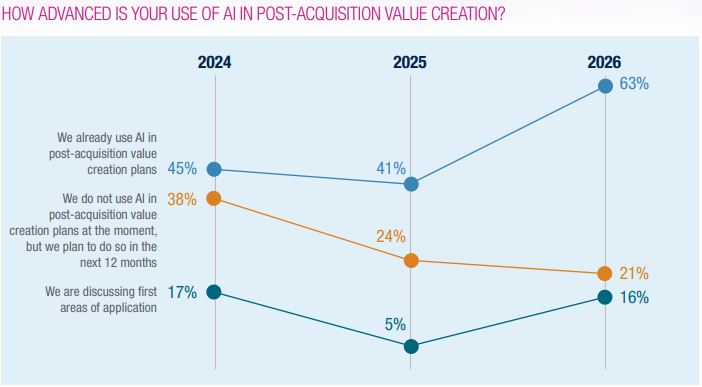
Artificial intelligence is also becoming more embedded in value-creation programs. Sixty-three percent of respondents said they already use AI in post-acquisition value creation, up from 41% last year. Data analysis and insight generation was the most common application, followed by operational-efficiency improvements and finance-function optimization.
The report also highlighted changes in exit strategies as private equity firms hold assets for longer. Forty-three percent of respondents said they were using secondary-market solutions or continuation funds, up from 24% a year earlier. Among assets transferred into continuation vehicles, 45% were described as performing in line with expectations but requiring additional time to achieve their full potential.
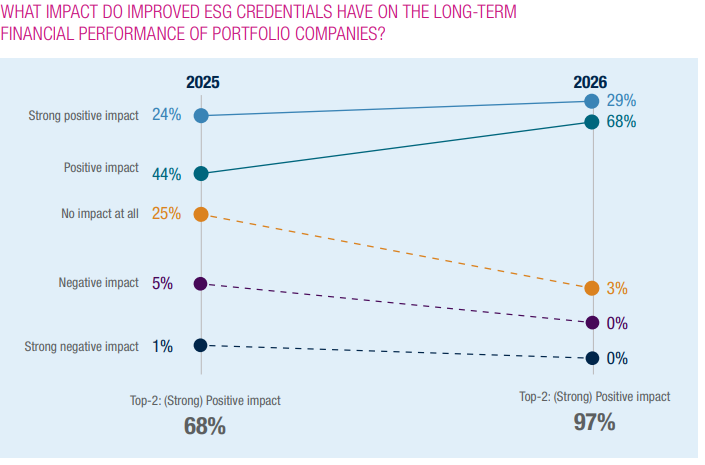
Investor confidence in the financial benefits of environmental, social and governance initiatives has also strengthened. Ninety-seven percent of respondents said improved ESG credentials have a strong positive or positive impact on long-term portfolio company performance, up from 68% a year earlier. The report recommended that firms begin value-creation planning during due diligence, pursue revenue, cost and cash initiatives simultaneously, strengthen pricing capabilities, focus AI deployment on measurable business outcomes and ensure continuation-fund assets are supported by credible execution plans.
The report is based on a survey of 200 private equity professionals and executives at private-equity-backed companies across 10 European markets conducted in the first quarter of 2026. Respondents included deal teams, operating teams and portfolio company managers from Denmark, France, Germany, Italy, the Netherlands, Norway, Spain, Sweden, Switzerland and the United Kingdom.